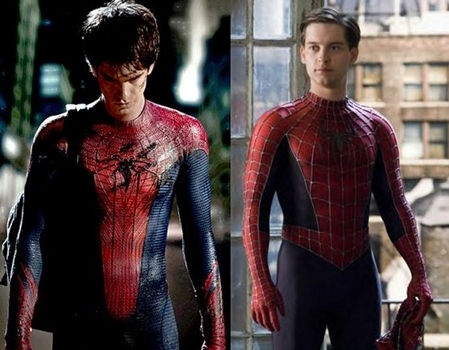
First
of all, you all should know that I am a huge Spider-man fan. Not only is Peter
Parker one of my favorite comic book characters, he is one of my favorite
fictional characters of all time, right up there with; Jay Gatz, Cameron Frye,
and Link. I saw the midnight showings of both Amazing Spider-man and Spider-man
3. So naturally I was excited for both of these movies, I went in to each
with big expectations, and walked out of both with mixed feelings. Spider-man 3 got me excited because of
how well done the two preceding movies were, especially Spider-man 2. I was also excited for the reboot because they seemed
to get a lot of things right that the originals missed, like Gwen Stacy or Spider-man
building his own web shooters. The thing is Amazing
Spider-man has been getting a lot of positive buzz, but is overall a very
poorly constructed movie, while Spider-man
3 is unjustly hated by many. The new Spider-man gets the details right but
misses the bigger picture. Now before I go any further I want to warn you
guys…Spoilers.
Working
at a movie theater, like I do, one hears customers saying a lot of stupid
things (like Avatar should win best picture), but this time I heard multiple people
say that Amazing Spider-man was
“better than any of the old ones,” which is just plain stupid. The original
movies, specifically Spider-man 2,
hit on what makes Peter parker such an engaging character. The more good he
does, the more it hurts him. In Spider-man
1 he chooses not to be with the girl he loves to protect her. In Amazing he is told by her dying father,
a police officer who gave his life to save Peter, not to be with her to protect
her, but then he does it anyway.
Of
course most reasonable people would agree that the first two Spider-man movies
were better than the new one, and I need to get to why Spider-man 3 specifically is better than Amazing. First off I feel like I need to explain exactly why the
series was rebooted instead of going on with a fourth Spider-man, like planned.
A lot of people seem to think that Spider-man
4 was never made because, like Batman
and Robin, it was so terrible that they thought the series was beyond saving
and just started over. This is completely wrong. After the critical and financial failure of Batman and Robin the studio tried to
make another for years, going through various directors and scripts until after
eight years, finally coming to the Oscar nominated director Christopher Nolan
to reinvigorate the series. The Spider-man series on the other hand was
restarted after only five years by an unheard of director. Also unlike Batman, Spider-man 3 was both a critical and
financial success. While many members of the public despised it, Spider-man 3 was warmly received by critics.
It currently holds a 63% on Rotten Tomatoes, a website that determines what
percentage of critics gave a film a positive review. To give that number some
context Watchmen has a 64%. Spider-man 3 also
made buckets of money, it has only recently been surpassed as the most financially
successful Marvel movie of all time (it’s now second behind The Avengers.)
So if
critics liked Spider-man-3, and it
made a ton of money, then was the fan outcry really big enough that it was
still rebooted? Nope. Why then? I’m glad you asked, it’s all studio politics.
See, a few years back Disney bought Marvel and got the film rights to most of
their characters, other than of course their really big ones that already had
deals with studios. Some of those characters were Spider-man and the X-men, whom
you may have noticed have both had reboots in the past year. You also may have
noticed that they were both absent from the big Marvel team up, The Avengers. Before Iron-Man came out none of those
Avengers, except possibly Hulk, were seen as very popular, and so the rights to
the much more valuable Spider-man and X-men were kept by Sony and Fox respectively.
After Spider-man 3 came out Sony had
a finite amount of time to make another Spider-man film or they would lose the
rights to him too. The director of the Spider-man trilogy, Sam Rami, wanted to
take his time to make the fourth film, but the studio wanted him to rush,
giving him an earlier planned release than he was comfortable with, so Rami
walked. Without Rami Tobey McGuire was unwilling to do another movie, and so
Sony scrambled to get a new Spider-man movie together, in order to keep the
rights. If you thought that Amazing Spider-man felt like a movie thrown
together as quickly as possible to make a quick buck you’re quite perceptive.
So
enough of the technical stuff, let’s get to the heart of the movies. Both are
flawed, but Spider-man 3’s flaw is that it simple has too much going on, much
like Iron-man 2. Amazing on the other hand is a complete mess or, at least the
second half is. Spider-man 3 is a
tale about revenge. Revenge touches the lives of every character in it. Peter
wants to take revenge on the Sandman for killing his Uncle Ben, and he wants
revenge on Mary Jane for breaking his heart. His revenge is represented
literally by the symbiote, which feeds off Peter’s desire for revenge and makes
him more powerful, but he grows further from the ones he loves and loses
himself. He has to let go of this power to become himself again, and stop doing
“Saturday Night Fever” dance numbers. Peter isn’t the only one motivated by
revenge however. His best friend Harry Osborne wants revenge on him from supposedly
killing his father, who became the villain Green Goblin. Harry follows in his
father’s footsteps in order to take his revenge on Peter. Once peter abandon’s
the symbiote it finds someone else hungry for revenge, Eddie Brock, who Peter
wronged, and now he too seeks revenge on Peter, and Eddie becomes Venom. All of
these plots come together in the end during a final battle between Sandman,
Spider-man, the new Green Goblin, and Venom.
Before
the battle Peter goes and seeks forgiveness of Harry, who at first denies him
but after Harry comes to the realization that it was his father’s own hatred
that caused his death, he arrives to help his old friend, letting go of his
quest for vengeance. During the battle Eddie becomes separated from the
symbiote, but is unable to let go of the power and his need for revenge and he
dies along with it. In the end Harry too sacrifices himself for his friend,
redeeming himself in death. Only Spider-man and Sandman are left when Sandman
tells Peter he has done terrible things, and asks for his forgiveness, which
Peter gives him. The Sandman turns to a wisp of sand and floats away,
metaphorically freeing both of them from this tragic cycle of vengeance. The
last shot of the movie is of Pater and Mary Jane reunited, knowing that they
have both hurt each other, but presumably trying to forgive one another. It’s a
powerful message. In Amazing Spider-man
Peter also deals with revenge, in fact he becomes Spider-man to take revenge on
the burglar who killed his uncle, not out of some desire for justice. Then then
forgets all of that revenge stuff because he literally creates a monster called
“The Lizard”. The burglar, who is Spider-man’s main motivation during the first
half of the film, is never mentioned in the second half other than a picture on
Peter’s nightstand.
“With
great power comes great responsibility,” also takes on new meaning in Amazing. In “Spider-man 3” he runs into
problems because he lets his personal vendettas becomes more important than
justice, his “great responsibility.” In Amazing
he only has a responsibility because he makes the monster. The whole second
half of Amazing Spider-man is a
B-movie. What’s especially problematic about this entire cheesy plot is how it completely
clashes with the overall feel of the movie. The movie desperately tries to make
Spider-man more “Modern” by having him do things like skateboard and wear
contact lenses. This doesn’t work well with a plot taken straight from the
Spider-man comics of the sixties, which are completely unrealistic by today’s
standards. Nothing important happens in the second half except for Spider-man
stopping some goofy science fiction plot to turn all the citizens of New York
City into lizards, and a bit of a love story. Some might say they intentionally
made a less complex plot to avoid overcomplicating the movie like Spider-man 3, but the thing is there
were many plots in the beginning of the movie that were simply forgotten during
the second half.
The
fact that so many plot lines were completely ignored in the end of the movie
was my main gripe. Having a plot carry over into the sequel is no problem, but this is something else altogether. A perfect example of a plot being set up for
the sequel is Harry Osborne’s hatred of Spider-man during Spider-man 2. He bares resentment against Peter for being
Spider-man’s photographer the entire film, and during the climax of the movie discovers
his true identity and his father’s weapons. This perfectly sets up the events
of the next film, while also moving the plot along sufficiently in Spider-man 2. Amazing Spider-man on the other hand just ignores major plot points
brought up until literally after the credits have started rolling. The first
half of the film revolved around Peter’s parents having to escape from
something (presumably Norman Osborne), Norman Osborne’s mysterious sickness,
and the burglar, along with of course Peter getting his powers. The film’s ad
campaign promised to “reveal the secret past of Spider-man,” and the first half
of the movie seemed to be shaping up to do just that. The movie even starts
with a flashback to Peter’s parents escaping someone with nefarious intent.
There is plenty of buildup to finding out the mystery of how they, Norman
Osborne and the scientist who became the lizard were connected. Then the second
half started and all we got was Spider-man stopping a giant Lizard from
releasing a poison gas that would make the New Yorkers lizardfolk. A horribly
short and vague scene was crammed into the middle of the credits that implied
that the Norman Osborne and Peter’s parents plots would be addressed in the
sequel (or possibly Iron Man 3 if
Disney and Sony work out some sort of deal, which is unlikely but possible.)
This awful tease is the only thing close to a resolution we get.
If
unresolved and B-movie plots aren’t enough to convince you, take the characters
into account. I’ve heard some people say that Andrew Garfield completely
outshone Tobey McGuire. I disagree with this pretty strongly, the way
the character is portrayed in the originals is still clearly superior. The Amazing version of Spider-man isn’t particularly
deep, and neither are any of the other characters. One major complaint of Spider-man 3 was “when he went emo.” I
thought that part was actually pretty funny, and it seemed less that Peter was
“emo” than a nerd trying desperately to be cool. It was corny, and people who
know Sami Rami movies know that he likes corny stuff that shouldn’t be taken
seriously, but people still took it very seriously. Amazing Spider-man takes things far too seriously on the other
hand, other than a few quips by Spider-man; it seems a lot closer to an emo
teen than Spider-man 3 ever did. It’s not just Peter that is a shallow
character in the new version. While I love Emma Stone and her performance was
great as always her character is written thinly at best. The most disappointing character in the movie
is none other than the mad scientist who becomes a villain. The Lizard in most portrayals
is a very tragic character; he is usually a family man who goes too far and end up endangering the one he loves. In Amazing he is just your basic mad
scientist. The villains in Spider-man 3
are all interesting and sympathetic characters. Venom is a dark reflection of
Spider-man, Harry is a tragic character who’s struggle between good and evil is
embodied in his decision to choose between his father’s legacy and his friend. Last
and perhaps most tragic of all is the Sandman, who became a criminal to help
his sick daughter, and became a monster by horrible accident. I admit, there are
a couple characters that really were better in Amazing, such as Flash and Martian Sheen’s portrayal of Uncle Ben,
but there was one major thing missing, J. Jonah Jamison. His omission is very noticeable;
in fact the likely reason he wasn’t in the movie was because J.K. Simmons
portrayed him absolutely perfectly. Who could top that performance? If you
don’t really believe he was that great of a character, here is proof:
All in
all neither movie is perfect. Spider-man
3 feels like a good story with too much stuff in it and that made a few
missteps (Harry amnesia), but still managed to tell an engaging story about
revenge. Amazing Spider-man feels
like a movie made to meet a deadline by people who don’t really know anything
about the character of Spider-man to tell the story of a guy fighting a big
lizard.

